

As a member of the Florida Forage Fish Coalition, Florida Wildlife Federation (FWF) has spent the last decade helping advance one of the state’s most overlooked conservation priorities: the research and protection of forage fish, the small species that support healthy marine ecosystems and robust angling opportunities across Florida.
Forage fish like pinfish, mullet, menhaden, and anchovies rarely get the spotlight. They don’t show up on tournament leaderboards or dinner menus the way redfish, trout, or grouper do. But they are the link in the food chain that makes those bigger, more celebrated species possible, along with the sea birds and marine mammals that depend on them too.
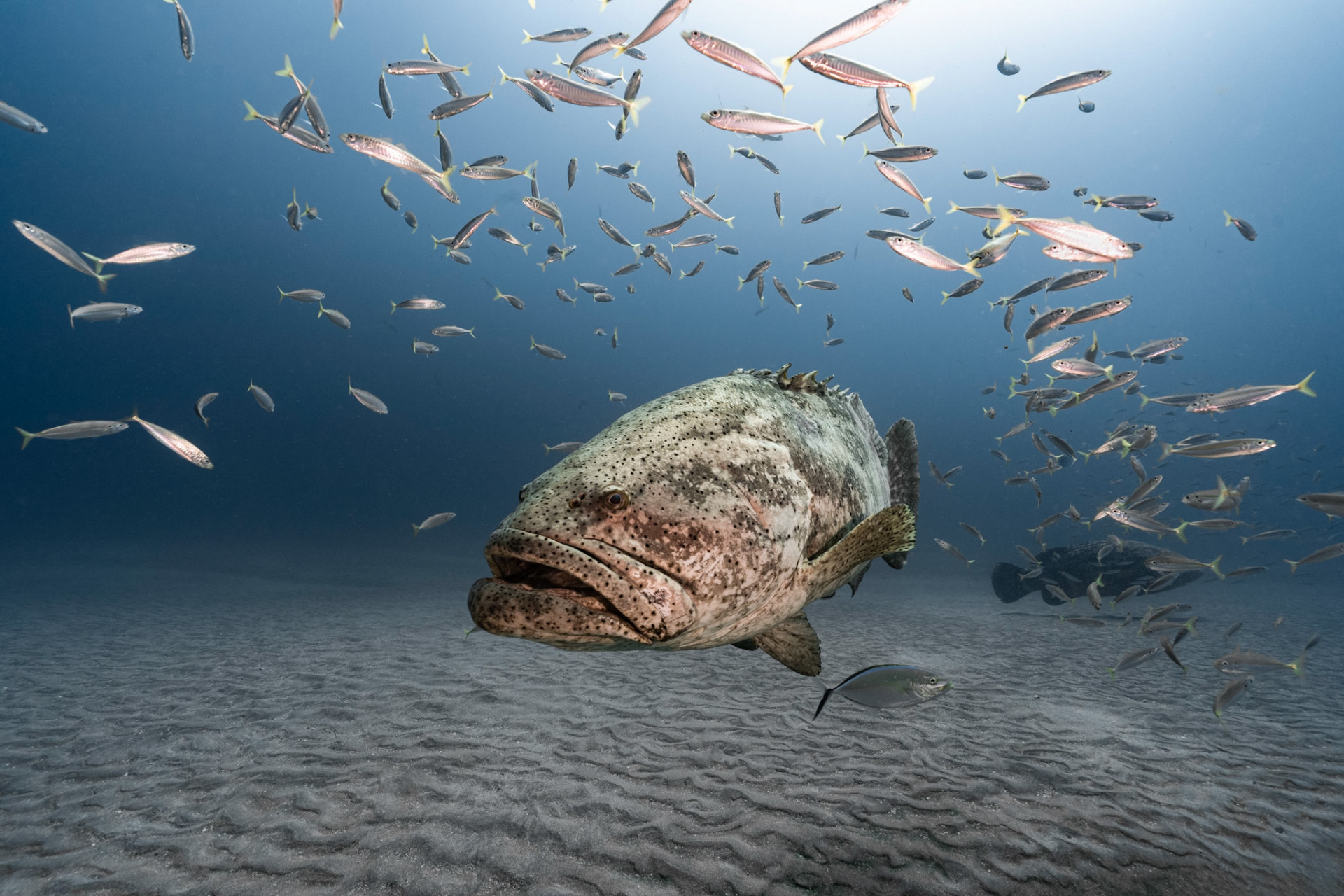
Goliath Grouper surrounded by forage fish. Photo by Rayna Onan
Stemming from the 2015 Forage Fish Resolution by the Florida Fish and Wildlife Commission (FWC) in support of continuing forage fish monitoring and management in Florida, the Forage Fish Research Program (FFRP) was established, advancing a crucial milestone that prioritized the research and conservation of the lower trophic level fishes that support healthy marine ecosystems and robust angling opportunities.
FWF, alongside other leading recreational fishing advocacy groups and environmental non-governmental organizations, has driven the Coalition that built the FFRP into a public-private partnership between state natural resource agencies, the FWC Fish and Wildlife Research Institute (FWRI), and leading academics, designed to enhance the state’s environmental and fishery research capacity while fostering the development of the next generation of marine scientists.
In 2016, the first FFRP Data Workshop was held at FWRI headquarters in St. Petersburg, Florida. This inaugural workshop brought together leading researchers from Florida universities and FWRI fishery scientists to identify research priorities that utilized FWRI’s more than 30 years of long-term fisheries independent monitoring and estuary data to address critical questions on fisheries, habitats, and changing ecosystem dynamics. The first two FFRP graduate student Fellowships were awarded in 2017.
In the decade since, the FFRP has awarded 17 Fellowships to graduate student researchers at five Florida universities who have produced 11 open access, peer-reviewed publications in scientific journals including PLOS One and Frontiers in Marine Science. FFRP supported research has been cited in fishery management initiatives including NOAA Fisheries Climate Vulnerability Assessments and influenced objectives in Florida Dept. of Environmental Protection’s Aquatic Preserve Management Plans. Thanks to the generosity of Florida’s recreational fishing organizations, $320,000 has been raised to support these Fellowships. See here for an overview of all past FFRP Fellows and their research.
Over the last decade, the FFRP brought on additional Data Partners, including the Southwest Florida Water Management District, Tampa Bay Estuary Program, and the Florida Department of Environmental Protection Office of Resilience and Coastal Protection’s Aquatic Preserve Program. Alongside FWRI’s research priorities and data availability, including long-term Fishery Independent Monitoring data, Fellows have been able to co-analyze additional data available from these partners to address broader research questions pertaining to the tropicalization of species range shifts and changes in forage fish community composition, as well as the impacts of environmental disturbances and shifting climate conditions on marine ecosystems and essential fish habitats.

Attendees from the 10th Annual FFRP Data Workshop
On Thursday, June 4, 2026, FWF joined our fellow Coalition members, the IGFA, Pew Charitable Trusts, Wild Oceans, Fish Florida, Angler Action Foundation, American Sportfishing Association, and the Tampa Bay Estuary Program, in the 10th Annual FFRP Data Workshop.
This year, current FFRP Fellows presented the results of their Fellowship research. Alex Walus, a Ph.D. student at the University of Florida, presented her Fellowship research titled “Tropicalization of forage fish community structure in the Gulf of Mexico,” followed by Meredith Pratt, a Ph.D. student from the University of Central Florida. Meredith’s Fellowship research was titled “Tracking Tropicalization: Long-Term Shifts in Fish Community Structure Across Florida’s East Coast Estuaries.” Two additional FFRP Fellowships will be awarded for the 2026-2027 Fellowship year, bringing the total number of Fellowships to 19.

Alex Walus, Ph.D. student at the University of Florida

Meredith Pratt, Ph.D. student from the University of Central Florida
Celebrating a decade since the FFRP’s inception, the 2026 FFRP Data Workshop marked a crucial milestone representing not just the completion of 17 graduate student Fellowships, but the successful continuation of robust collaborations and partnerships. These relationships have been vital to the success of the FFRP and embody the win-win-win scenario for Florida’s fisheries, including advancing coastal natural resource research and management, developing the next generation of marine scientists, and improving the public’s understanding of the ecosystem roles of forage fish and the environmental connections to better angling opportunities.
Protecting Florida’s wildlife means protecting the species that hold the whole system together, even the small, overlooked ones. That’s exactly why FWF has remained an active member of the Florida Forage Fish Coalition.
Entering the program’s 11th year, the capacity for this highly successful public-private partnership has never been higher to address crucial forage fish and environmental related question. For more information about the Fellows and the program, go to floridaforagefish.org and please see the program infographic here.


